Integrating the Happy Birthday Card Mermaid Design into Your Creative Workflow
In the realm of digital crafting and small-scale production, the efficiency of your asset library directly correlates with your output quality and speed. For creators managing a steady stream of personalized projects, having reliable, high-quality designs ready for deployment is essential. The Happy Birthday Card Mermaid represents more than just a seasonal graphic; it is a strategic asset designed to streamline the card-making process for professionals, hobbyists, and small business owners alike. By understanding how to integrate this specific 3D SVG file into your existing workflow, you can reduce preparation time, ensure consistent cutting results, and deliver a premium product that stands out in a crowded market.
This design is specifically engineered for compatibility with industry-standard software such as Silhouette Studio and Cricut Design Space. However, its utility extends beyond these platforms, provided the user verifies file compatibility with their specific machinery. The core value proposition here lies in the transition from a conceptual idea to a tangible, cut-ready file without the need for extensive vector tracing or manual node editing. When you download this design, typically contained within a zipped folder for organized storage, you are acquiring a pre-validated component that fits seamlessly into a broader production pipeline.
Pre-Production Planning and Asset Management
Before any blade touches material, successful execution begins with organization. Integrating the Happy Birthday Card Mermaid into your workflow starts at the acquisition and filing stage. Upon downloading the zipped folder, immediate extraction and systematic naming conventions are crucial. For freelancers and small business owners who manage hundreds of designs, losing track of a specific file version can lead to costly delays. Store the SVG file in a dedicated directory alongside your standard color profiles and material settings.
Compatibility checks are the first critical step in the pre-production phase. While the design is optimized for Silhouette and Cricut ecosystems, users operating alternative cutting machines must verify that their software accepts standard SVG inputs. This verification prevents mid-project failures where a design might import with broken paths or incorrect scaling. Once confirmed, open the file in your preferred design software to inspect the layers. A well-structured 3D SVG will have distinct layers for the base card, the mermaid silhouette, and any intricate overlay details. Ensuring these layers are grouped correctly before sending the job to the cutter is a vital quality control measure.
Material Selection and Machine Configuration
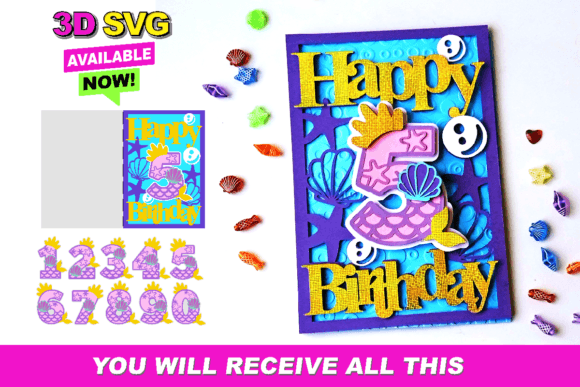
The "3D" aspect of this mermaid design implies depth, often achieved through layering different materials or utilizing scored fold lines to create pop-up elements. This requires a thoughtful approach to material selection. Standard cardstock may suffice for single-layer applications, but for a true 3D effect, consider varying weights and textures. Heavier cardstock provides structural integrity for standing elements, while lighter papers work well for delicate overlays. The success of the Happy Birthday Card Mermaid project hinges on matching the material properties to the complexity of the cut.
When configuring your machine, precision is paramount. The intricate details of a mermaid tail or flowing hair require sharp blades and appropriate pressure settings. In Silhouette Studio, utilize the "Test Cut" feature on a scrap piece of your chosen material to fine-tune force and speed. Similarly, in Cricut Design Space, select the specific material setting that mirrors your stock rather than relying on generic defaults. If the design includes score lines for folding, ensure your scoring tool is calibrated correctly to create crisp creases without tearing the paper fibers. This attention to detail during the setup phase ensures that the assembly process later is smooth and frustration-free.
Execution: From Digital File to Physical Prototype
Once the machine parameters are set, the cutting process transforms the digital asset into physical components. Monitor the first run closely. Even with a perfect digital file, environmental factors like humidity or slight variations in paper grain can affect the cut. The goal is to achieve clean weeding—where excess material is removed easily without pulling up essential parts of the mermaid design. If you find that small details are lifting or not cutting through, pause and adjust your settings immediately. This iterative approach is standard practice for maintaining high quality control in a production environment.
After cutting, the weeding process requires patience and the right tools. Use a sharp weeding hook or tweezers to remove negative space, particularly around the complex curves of the mermaid illustration. For 3D elements, take care not to distort the paper while removing surrounding waste. At this stage, the individual components of the Happy Birthday Card Mermaid should be laid out in order of assembly. Organizing the pieces logically before applying adhesive saves time and reduces the risk of misalignment, which is difficult to correct once glue is applied.
Assembly Techniques for Professional Results
Assembly is where the 3D nature of the design truly comes to life. This stage involves bonding the layered elements to create depth. Foam adhesive squares are highly recommended for lifting the mermaid figure off the card base, creating a shadow effect that enhances the visual appeal. For flat layers, a thin line of liquid glue or a double-sided tape runner ensures a secure bond without warping the paper. Consistency in adhesive application is key; too much glue can cause seepage, while too little leads to delamination over time.
For those producing these cards in batches for a small business or event, establishing an assembly line workflow increases efficiency. Dedicate one station to applying adhesive, another to positioning the mermaid layers, and a final station for quality inspection. During inspection, check for symmetry, secure adhesion, and clean edges. Any card that does not meet your standards should be reworked or discarded immediately to maintain brand reputation. This rigorous approach ensures that every Happy Birthday Card Mermaid leaving your workspace meets professional expectations.
Scalability and Long-Term Utility
Beyond a single project, this design serves as a versatile template for various use cases. Educators can use it for marine biology-themed classroom activities, while marketers might incorporate it into promotional campaigns for beach-related businesses. The scalability of the SVG format allows you to resize the design without losing resolution, making it adaptable for invitations, gift tags, or even larger wall decor. By mastering the workflow for this specific design, you develop a repeatable process that can be applied to future 3D SVG projects, enhancing your overall operational efficiency.
Furthermore, maintaining a library of such assets supports long-term productivity. When a rush order arrives or a last-minute birthday invitation is needed, having a pre-vetted, cut-ready file like the mermaid design eliminates the design phase entirely. You move straight to production, significantly reducing turnaround time. This readiness is a competitive advantage for entrepreneurs and freelancers who bill by the hour or compete on delivery speed.
Troubleshooting and Optimization
Even with a robust workflow, challenges may arise. If the mermaid details appear jagged, revisit your SVG import settings; sometimes simplifying the curve tolerance in the software can smooth out rough edges. If the layers do not align perfectly during assembly, check the registration marks or ensure that the material did not shift during the cutting process. Using a mat with strong grip can prevent slippage. Additionally, always keep your software updated to ensure full compatibility with the latest SVG standards and machine firmware.
Ultimately, the value of the Happy Birthday Card Mermaid lies in its ability to bridge the gap between creative vision and practical execution. It is a tool that, when used with a methodical approach, enhances the quality of your output and streamlines your creative operations. Whether you are a seasoned crafter optimizing a home studio or a business owner scaling production, integrating this design into your process offers a clear path to efficient, high-quality results. By focusing on preparation, precise execution, and systematic assembly, you transform a simple digital file into a cherished physical keepsake.