Crafting Sweet Memories: The Ultimate Guide to 3D Ice Cream Birthday Cards
The evolution of greeting cards has moved far beyond the flat, mass-produced paper goods found in supermarket aisles. In an era where personalization is paramount, creators and hobbyists are turning to digital cutting machines to produce intricate, dimensional designs that convey emotion through craftsmanship. Among the most delightful trends in this space is the Happy Birthday Card Ice Cream design. This specific motif combines the universal joy of a birthday celebration with the whimsical charm of a frozen treat, resulting in a keepsake that recipients often cherish long after the cake has been eaten. For professionals, educators, and small business owners alike, understanding how to leverage these 3D SVG files can open new avenues for creative expression and commercial opportunity.
The Appeal of Dimensional Paper Crafting
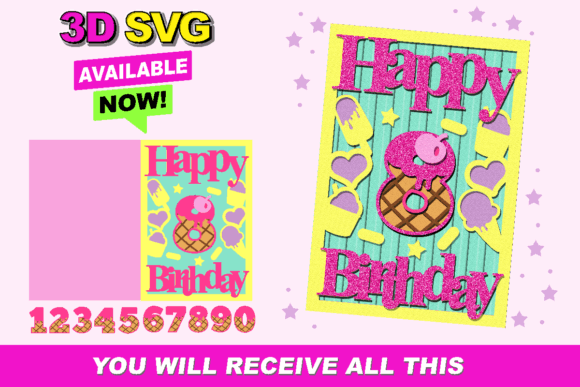
Three-dimensional paper crafting, often referred to as pop-up or layering card making, adds a tactile element to gift-giving that flat cards simply cannot match. When a recipient opens a card and an ice cream cone rises from the page, complete with scoops, sprinkles, and a cherry on top, it creates a moment of surprise and delight. This reaction is driven by the depth and shadow play inherent in layered designs. Unlike traditional printing, which relies solely on ink, 3D cards utilize the physical properties of cardstock to create structure.
The Happy Birthday Card Ice Cream theme is particularly effective in this medium because the subject matter naturally lends itself to stacking. Ice cream scoops are inherently round and stackable, making them ideal candidates for layering techniques. Each scoop can be a different color or pattern of paper, allowing the creator to customize the flavor profile visually. Furthermore, the addition of a waffle cone texture at the base provides a sturdy foundation for the design, ensuring the card stands up well when displayed on a mantle or desk.
Navigating File Formats and Software Compatibility
For those entering the world of digital die-cutting, the file format is the bridge between the designer's vision and the final physical product. The industry standard for these projects is the SVG (Scalable Vector Graphics) file. This format is crucial because it allows images to be resized without losing resolution or clarity. Whether you are creating a miniature card for a gift tag or a large centerpiece for a party table, the SVG ensures crisp cut lines every time.
Most modern crafting ecosystems revolve around two primary software platforms: Silhouette Studio and Cricut Design Space. These programs are designed to interpret SVG data and translate it into cutting instructions for their respective machines. A high-quality Happy Birthday Card Ice Cream download typically arrives in a zipped folder containing multiple file types. While the SVG is the star of the show for cutting machines, these folders often include PNG or JPEG previews for reference, and sometimes DXF files for older cutting machines that do not support SVG natively.
It is vital for users to verify their machine's compatibility before purchasing or downloading files. If you are using a legacy machine or a brand outside the major two, you must ensure your software can import SVGs or that the provider offers a compatible alternative. Attempting to force an incompatible file type can lead to frustrated troubleshooting sessions and wasted material. Once the file is imported, the user can manipulate individual layers. This is where the magic happens; creators can change the size of the scoops, rotate the cone, or even remove specific elements like sprinkles to simplify the cut for thinner cardstock.
Material Selection for Structural Integrity
The success of a 3D card project hinges not just on the digital file, but on the physical materials used. Paper weight, measured in pounds (lbs) or grams per square meter (gsm), is the most critical variable. For a Happy Birthday Card Ice Cream card to maintain its shape, the base cardstock should generally be between 65 lbs and 80 lbs cover weight. Lighter papers may flop over, failing to support the weight of the layered scoops, while papers heavier than 110 lbs can be difficult for some home cutting machines to slice through cleanly, leading to tearing or incomplete cuts.
Texture also plays a significant role in the realism of the design. Using textured cardstock that mimics the grid pattern of a waffle cone can elevate the project from a cute craft to a professional-grade piece. Similarly, pearlescent or glitter papers can be used for the ice cream scoops to simulate the creamy, rich texture of real dessert. However, crafters must exercise caution with glitter paper; the abrasive surface can dull blade tips quickly. It is often advisable to perform a test cut on a small scrap of the chosen material to adjust blade depth, pressure, and speed settings before committing to the full design.
Assembly Techniques and Best Practices
Once the pieces are cut, the assembly process begins. This stage requires patience and precision. The layers in a Happy Birthday Card Ice Cream SVG are usually numbered or color-coded in the software to indicate the stacking order. Generally, the largest pieces form the base, with progressively smaller pieces layered on top to create the illusion of depth. Foam adhesive tabs are the secret weapon in this process. Unlike liquid glue, which can warp paper and flatten the layers, foam tabs provide elevation. By placing these tabs between the layers of ice cream scoops, the card gains significant dimension, casting shadows that make the image pop.
When assembling the cone, it is often effective to curl the paper slightly before adhering it to the card base. This subtle curve mimics the natural shape of a real cone and prevents the card from looking too rigid. For the "melting" effect, some designers add a small drip of white cardstock flowing down the side of the cone, secured with a single point of glue to allow it to lift slightly off the page. This attention to detail transforms a static image into a dynamic scene.
Commercial and Educational Applications
Beyond personal hobby use, these 3D designs hold substantial value for small business owners and educators. For boutique card shops and Etsy sellers, offering handmade, dimensional cards allows for a higher price point compared to flat cards. The labor involved in cutting, weeding, and assembling justifies the premium, especially when the end result is a unique piece of art. A Happy Birthday Card Ice Cream can be part of a seasonal collection, appealing to customers looking for something distinct for summer birthdays or ice-cream-themed parties.
In educational settings, these projects serve as excellent tools for teaching fine motor skills, spatial reasoning, and following sequential instructions. Teachers can use the layered nature of the SVG files to teach concepts of geometry and layering to students. By assigning different colors to different layers, educators can create collaborative classroom projects where each student contributes a part of the whole. Furthermore, for therapy contexts, the repetitive motion of weeding excess paper and the precise placement required for assembly can be beneficial for developing hand-eye coordination.
Customization and Creative Variations
The true power of digital files lies in their modifiability. A standard Happy Birthday Card Ice Cream template is merely a starting point. Creators can easily swap out the "flavors" by changing the paper colors to match a specific party theme, such as pastel tones for a baby shower or bold primary colors for a child's birthday. The text on the card can also be customized within the design software. Instead of a generic "Happy Birthday," users can insert names, ages, or inside jokes, making the card deeply personal.
Additionally, the scale of the project can be adjusted infinitely. The same file used for a standard A2 greeting card can be scaled up to create a large wall decoration for a photo booth backdrop at an ice cream social. Conversely, scaling it down allows for the creation of matching gift tags, cupcake toppers, or even jewelry charms if cut from shrink plastic or thin acrylic. This versatility ensures that a single purchase of a digital file can yield multiple types of products, maximizing the return on investment for the creator.
Troubleshooting Common Cutting Issues
Even with the best files and machines, issues can arise. One common problem is "corner lifting," where the blade drags the paper at sharp turns, ruining the cut. This is often solved by reducing the cutting speed in the software settings. Another frequent issue is incomplete cuts on intricate details like sprinkles. If the machine fails to cut all the way through, it is better to run a second pass with the same settings rather than increasing the pressure drastically, which can crush the paper fibers. Always ensure the cutting mat is clean and has adequate tack; if the paper shifts during the cut, the intricate layers of the ice cream design will not align correctly during assembly.
Ultimately, the journey from a digital Happy Birthday Card Ice Cream SVG to a finished physical card is a rewarding process that blends technology with traditional artistry. Whether for a professional crafter looking to expand their inventory, a teacher seeking an engaging classroom activity, or a friend wanting to give a truly memorable gift, these 3D designs offer endless possibilities. By understanding the nuances of file formats, material selection, and assembly techniques, anyone can master the art of creating sweet, dimensional memories that stand out in a world of digital communication.