Revolutionizing Custom Fabrication with the Clay Cutter STL File - Circle Bezel 4
The intersection of digital design and tangible craftsmanship has never been more vibrant. For professionals, creators, and entrepreneurs looking to streamline their production workflows while maintaining a high degree of customization, the adoption of additive manufacturing tools is no longer optional—it is essential. At the forefront of this shift is the Clay Cutter STL File - Circle Bezel 4, a digital asset that represents more than just a file; it signifies a fundamental change in how we approach the creation of jewelry, confectionery, and decorative arts. This tool allows users to bypass traditional manufacturing bottlenecks, offering immediate access to precision-engineered cutting profiles that can be deployed instantly via a standard 3D printer.
The Evolution of Digital Assets in Creative Industries
In the past, acquiring a specific tool for a niche application—such as a bezel cutter for polymer clay earrings or a precise shape for fondant decoration—required waiting for shipping, paying premium prices for low-volume runs, or settling for generic shapes that did not fit a specific brand aesthetic. The market has shifted dramatically toward on-demand fabrication. The Clay Cutter STL File - Circle Bezel 4 fits perfectly into this broader industry trend where digital inventory replaces physical warehousing. By downloading a bundle of clay cutter STL digital download files, creators are essentially purchasing the capability to manufacture their own tools, reducing lead times from weeks to hours.
This transition appeals to a diverse audience ranging from freelance jewelry designers to small-batch cookie decorators. The ability to curate custom and unique cutter combos easily with other STL files available in modern stores empowers entrepreneurs to react swiftly to consumer trends. If a specific size or style becomes popular on social media, a creator with a 3D printer and the right digital files can produce the necessary tooling immediately, capitalizing on the trend before it fades. This agility is a critical competitive advantage in today's fast-paced creative economy.
Precision Engineering for Versatile Applications
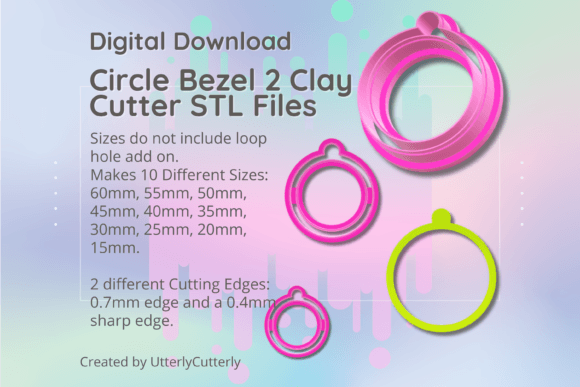
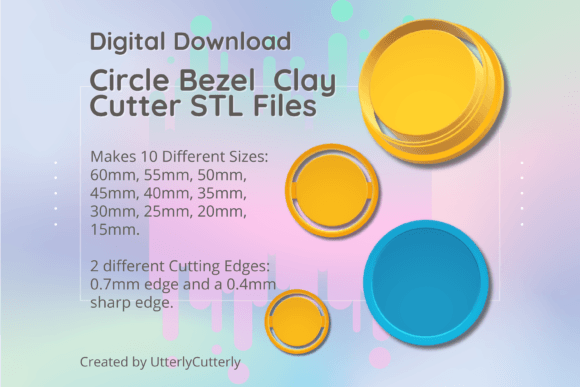
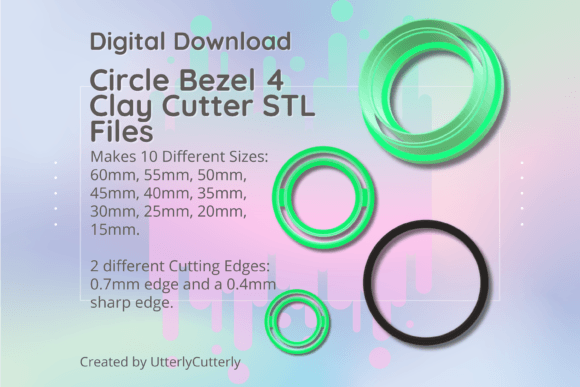
What makes the Clay Cutter STL File - Circle Bezel 4 particularly noteworthy is its engineering specificity. It is not merely a circle; it is a sophisticated system designed to accommodate various material densities and project requirements. The pack includes 10 different sizes, ranging from a delicate 15mm up to a substantial 60mm, measured from the longest ends. This granularity allows for a seamless workflow whether one is crafting miniature pendant components or large statement barrettes.
Furthermore, the design acknowledges the varying needs of different mediums. For instance, working with polymer clay requires a different approach than cutting through rolled cookie dough or fondant. To address this, the file bundle offers two distinct cutting edge types. The first option features a 0.7mm wall with a 3mm thick base and a height of 12mm, providing robustness for heavier materials. The second option, abbreviated as SE (Sharp Edge) in the files, utilizes a 1mm support wall with an ultra-fine cutting edge of 0.4mm. This sharp edge is crucial for achieving clean cuts in delicate fondant or thin layers of clay without dragging or distorting the material.
Optimizing Workflows for Jewelry and Culinary Artists
The relevance of these digital files extends beyond mere convenience; they solve specific technical challenges faced by artisans. A common issue in bezel setting for jewelry is ensuring the frame thickness is consistent to hold stones or inserts securely. The Clay Cutter STL File - Circle Bezel 4 leaves a precise frame of 2.5mm thick, ensuring uniformity across every piece produced. This level of consistency is difficult to achieve with manual cutting methods and often expensive to outsource.
For those integrating embossing details into their designs, the files are optimized with embossing lines that stand 10.5mm tall. This specification dictates a practical workflow requirement: users must work on clay thicker than 1.5mm to ensure the embossing registers correctly without piercing through the material. This kind of embedded instruction within the design parameters helps prevent material waste and ensures professional results, catering to both novices and seasoned professionals who demand reliability.
Consider the workflow of a jewelry entrepreneur launching a new line of geometric earrings. Instead of ordering custom metal dies, they can print a set of cutters in varying sizes (e.g., 20mm, 25mm, 30mm) overnight. They can then experiment with different clay colors and textures, producing prototypes and final products in the same day. Similarly, a bakery specializing in custom cookies can offer clients bespoke circular designs that match specific event themes, printing the required cutter sizes on demand rather than stocking hundreds of physical units that may never be used.
The Broader Impact of Distributed Manufacturing
The popularity of files like the Clay Cutter STL File - Circle Bezel 4 highlights a larger development in the maker movement and small business sector: distributed manufacturing. By decentralizing the production of tools, we reduce the carbon footprint associated with shipping physical goods globally. A digital file can be transferred instantly, and the physical object is created locally, using only the necessary amount of biodegradable or recyclable filament. This aligns with growing consumer expectations for sustainability and ethical production practices.
Moreover, the ecosystem surrounding these files is dynamic. With new STL files coming to stores every week, the library of available designs is constantly expanding. This encourages a culture of continuous learning and adaptation. Creators are not locked into a static catalog; they can mix and match designs, combining the circle bezel with other geometric or organic shapes to create entirely new product lines. This modularity fosters innovation, allowing freelancers and small studios to punch above their weight class in terms of design variety.
Practical Considerations for Implementation
Adopting this technology requires a shift in mindset and a basic understanding of 3D printing parameters. It is important to remember that this is not a physical item; it is a digital license to create. Users must have access to a 3D printer capable of handling the resolution required for sharp cutting edges. The "Sharp Edge" variant, with its 0.4mm cutting profile, demands a well-calibrated printer to ensure the layer lines do not interfere with the cutting action. However, once calibrated, the repeatability is unmatched.
For businesses, the return on investment is clear. The cost of a single spool of filament can yield dozens of cutters, each replacing a tool that might cost $10 to $20 if purchased traditionally. Over time, the savings are substantial, but the real value lies in the speed to market. In an era where trends cycle rapidly, the ability to iterate designs overnight is invaluable.
In conclusion, the Clay Cutter STL File - Circle Bezel 4 is more than a utility; it is an enabler of creativity and efficiency. It bridges the gap between digital potential and physical reality, offering a versatile solution for jewelry makers, bakers, and crafters alike. By embracing these digital tools, professionals can future-proof their workflows, reduce overheads, and deliver highly customized products that resonate with modern consumers. As the technology continues to mature and the library of available designs expands, the barrier to entry for high-quality custom fabrication will continue to lower, democratizing access to professional-grade tooling for enthusiasts and entrepreneurs around the globe.